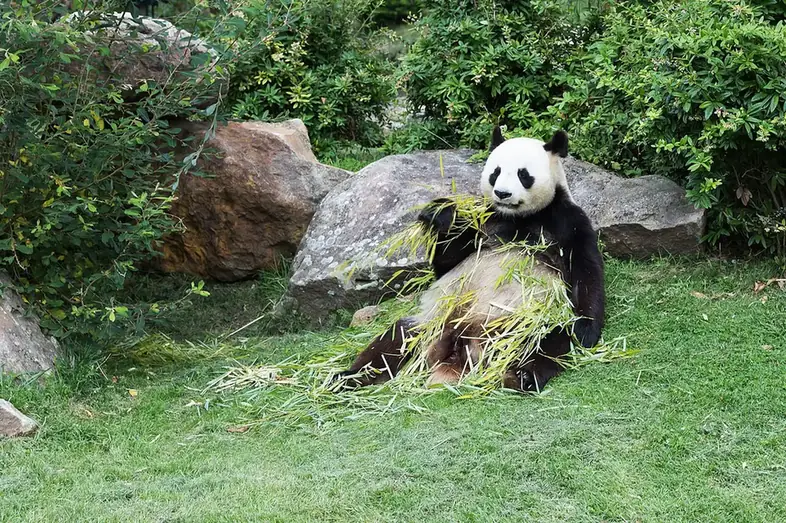
The panda (熊猫, xióng māo), whose Chinese name means bear cat, is a large mammal native to the temperate bamboo forests of central China. The character 熊 (xióng) means bear, and 猫 (māo) means cat, reflecting early naturalists' perception of the panda as a bear-like creature with cat-like features. Ecologically, the panda is classified as a carnivoran that has evolved to subsist almost entirely on bamboo, a dietary specialization that defines its habitat, behavior, and life cycle. Its native range is concentrated in the mountainous regions of Sichuan, with significant populations also found in Yunnan and along the upper reaches of the Yangtze River. The panda's biological identity is thus inseparable from the geography of southern and central China.
The panda occupies a unique position at the intersection of natural ecology and Chinese cultural symbolism. In Daoist thought, the panda's simple, unhurried existence exemplifies harmony with nature: it eats when hungry, rests when tired, and follows the rhythms of bamboo growth without resistance or aggression. The panda's relationship to harmony is reflected in its peaceful, non-aggressive nature, which aligns with Daoist ideals of effortless action. Its monochrome black-and-white coloring has been interpreted as a living embodiment of yin-yang balance, the two complementary forces that structure all existence. The panda's absolute dependence on bamboo, a plant with profound cultural significance in Chinese aesthetics and daily life, further ties this animal to the philosophical and material fabric of Chinese civilization. Through its connections to lotus, jade, and porcelain, the panda also participates in the visual language of Chinese art.
The panda manifests across multiple domains of Chinese culture and ecology. In the bamboo forests of Sichuan, the panda shares its watershed with the Yangtze River, one of China's great cultural and geographical arteries. Bamboo baskets, woven from the same plant that sustains the panda, represent one of China's most ancient and enduring crafts, connecting the animal to the material culture of daily life. In art and visual culture, the panda appears in paintings and on porcelain alongside bamboo stalks, lotus flowers, and misty mountain landscapes that evoke the regions of Jiangnan and Sichuan. The spring festival often features panda imagery as a symbol of good fortune, natural vitality, and renewal. The panda's association with Mount Tai, one of China's five sacred mountains, connects it to the spiritual geography of the nation. Even in the culinary landscape, the panda's habitat overlaps with regions known for Sichuan pepper, rice cultivation, mulberry groves, and fermentation traditions.
In the modern era, the panda has become the most globally recognizable symbol of wildlife conservation and ecological intelligence. China's network of panda reserves, established across Sichuan and neighboring provinces, demonstrates a sophisticated understanding of the relationship between species protection and whole-ecosystem health. The panda's journey from endangered status toward recovery through habitat corridor preservation, bamboo reforestation, and captive breeding represents a model of ecological intelligence in action: protecting a single species means protecting an entire web of dependencies, from bamboo groves to the Yangtze River watershed. The panda also serves as a diplomatic symbol, its image carried in cultural exchanges that link China to the global conservation community. In contemporary environmental discourse, the panda embodies the insight that a charismatic species can serve as an umbrella under which entire ecosystems are preserved.
In The Way of Nature Atlas, the Panda represents the living intersection of ecology, culture, and philosophy. Its dependence on bamboo, its origins in Sichuan and Yunnan, its presence along the Yangtze River, and its symbolic resonance with harmony, Daoism, and yin-yang make it one of the most richly connected entities in the atlas. The panda connects bamboo to craft through baskets, relates Sichuan to Yunnan as source regions, ties the spring festival to symbols of renewal, and links ecological intelligence to the survival of natural heritage. The panda is not merely an animal but a node through which the relationships between landscape, philosophy, craft, and conservation flow. It reminds atlas explorers that the natural world and the cultural world are not separate but woven together as tightly as bamboo threads in a Sichuan basket.