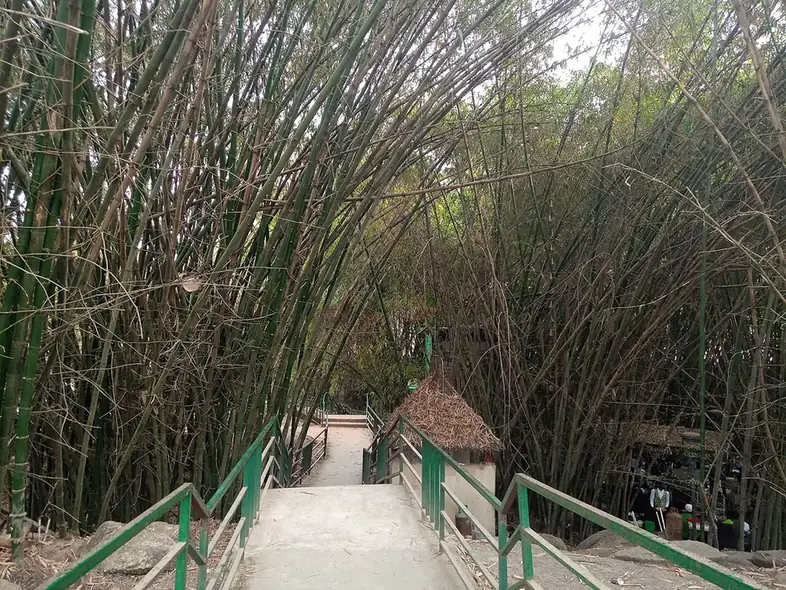
Bamboo backdrop
Entity Profile

Bamboo

Plant Level 1 — Concrete The Way of Nature Atlas ↗ #plant #east-asia #grass #fast-growing

Bamboo (竹子) is a fast-growing grass species in the subfamily Bambusoideae, native to East and Southeast Asia, valued for its ecological, cultural, and practical significance.

Plant
primary type
Level 1
Concrete entity
19
relationships mapped
Overview

About Bamboo

Bamboo (竹子, zhúzi) belongs to the subfamily Bambusoideae of the grass family Poaceae, making it technically a giant grass rather than a tree. Over 1,400 species exist worldwide, with the highest concentration in East and Southeast Asia. Bamboo is renowned for its rapid growth—some species can grow up to 91 cm (36 inches) per day—and its remarkable tensile strength, which rivals steel in certain applications.

Bamboo thrives in warm, humid climates across diverse altitudes, from lowland tropics to mountainous regions above 3,000 meters. It forms extensive groves through underground rhizome networks, playing a critical ecological role in soil stabilization and carbon sequestration. In East Asia, bamboo forests create distinctive microhabitats that support unique flora and fauna, including the giant panda (熊猫, xióngmāo), whose diet consists almost entirely of bamboo.

In Chinese culture, bamboo (竹子) is one of the Four Gentlemen (四君子, sì jūnzǐ) alongside plum, orchid, and chrysanthemum, symbolizing resilience, integrity, and humility. Its ability to bend without breaking in strong winds embodies the virtue of flexibility in Confucian and Daoist philosophy. Bamboo appears extensively in traditional Chinese painting, poetry, and literature as a metaphor for the ideal character—hollow inside (representing modesty), straight (representing righteousness), and evergreen (representing endurance).

Beyond cultural symbolism, bamboo is one of the most versatile natural materials in East Asian life. Its young shoots are harvested as a prized seasonal vegetable (竹笋, zhúsǔn). Mature culms are used in construction, furniture, baskets (竹篮, zhúlán), musical instruments, and papermaking. The fibers are processed into textiles and the leaves used for wrapping food. In traditional Chinese medicine, bamboo leaf extract is used for its cooling and anti-inflammatory properties.
Relationship Network

How Bamboo connects

Each relationship represents a meaningful semantic link between Bamboo and other entities in the Atlas knowledge graph.

Seasonal Timing

Bamboo across the solar year

These 24 solar terms mark when Bamboo appears, peaks, or transforms through the seasons.

谷雨 Spring

Grain Rain

Solar term #6 · Apr 19-21 · Earth

Bamboo shoot season begins

View on Dao of Seasons ↗
立夏 Summer

Start of Summer

Solar term #7 · May 5-7 · Fire

Peak shoot season

View on Dao of Seasons ↗
夏至 Summer

Summer Solstice

Solar term #10 · Jun 20-22 · Fire

Shoot season ending

View on Dao of Seasons ↗
Entity Constellation

Entities connected to Bamboo

These entities share semantic relationships with Bamboo in the Atlas knowledge graph.

Panda

熊猫
Concept L1

The panda (熊猫, xióng māo) is an iconic species native to the bamboo forests of Sichuan, Yunnan, and the Yangtze River ba ...

Bamboo Basket

Artifact L1

Bamboo Basket (竹篮, zhú lán) is a woven container crafted from split bamboo strips, used across East Asia for thousands o ...

Jiangnan

江南
Place L1

Jiangnan (江南, literally 'south of the Yangtze') is a culturally and historically rich region in southeastern China, enco ...

Sichuan

四川
Place L1

Sichuan (四川, Sìchuān) is a province in southwestern China, renowned for its dramatic topography encompassing the Sichuan ...

Mulberry

Plant L1

Mulberry (桑树) is a genus of deciduous trees in the family Moraceae, native to warm temperate and subtropical regions of ...

Calligraphy

Practice L1

书法 (Shūfǎ) is the art of expressive brush writing that embodies China's philosophical and aesthetic traditions. Combinin ...

Silk Reeling

Practice L1

Silk Reeling (缠丝劲, chán sī jìn) is a fundamental internal movement practice within Chen-style Tai Chi, characterized by ...

Spring Festival

春节
Festival L1

The Spring Festival, also known as Chinese New Year, is the most important traditional festival in Chinese culture. It m ...

Shen Nong

神农
Person L1

Shen Nong (神农, Shén Nóng, "Divine Farmer") is a legendary cultural hero and mythological emperor of ancient China, tradi ...

Ink Stick

Artifact L1

Ink Stick (墨, mò) is a solid block of ink used in traditional East Asian calligraphy and brush painting

Pine

Plant L1

Pine (松树) is a genus of coniferous evergreen trees in the family Pinaceae, widely distributed across the Northern Hemisp ...

Bamboo Shoot

Ingredient L1

Bamboo shoots (竹笋, zhúsǔn) are the edible young culms of bamboo species, harvested when they first emerge from the groun ...

Naming

Also known as

竹子 (synonym) Zhúzi (synonym) Bamboo (synonym) Sasa (Japanese) (synonym) Bambú (synonym)
Atlas Role

Bamboo in the Atlas

What this entity provides

Bamboo (竹子) is the Atlas's most cross-domain plant entity: it is simultaneously a construction material (Artifact), a food source (Ingredient: bamboo-shoot), an animal habitat (panda), a cultural symbol (Four Gentlemen), and a raw material for multiple crafts (baskets, brushes, paper). Its fast-growing, rhizome-based reproduction embodies the Daoist principle of yielding strength.

What it does NOT duplicate
  • bamboo-basket—which is a specific artifact made from bamboo
  • bamboo-shoot—which is the edible young culm, not the mature plant
Subsite References
tea-culture

Bamboo is the material of choice for tea whisks, scoops, and storage containers.

taichi-institute

Bamboo's ability to bend without breaking is the literal metaphor for tai chi's yielding principle.

dao-of-seasons

Bamboo shoots emerge at Grain Rain—a key phenological signal in the agricultural calendar.

Sources & References

References for Bamboo

Visual Gallery

Bamboo in imagery

Bamboo — visual reference
Watch

See Bamboo in motion

Green forest life · 5.3M views · YouTube ↗

Nature's Always Right · 2.9M views · YouTube ↗

Owner Site

The Way of Nature Atlas

Central Atlas — provides Overview pages for all entities. Does not produce original entity content, only aggregates and references.

ConceptCraftMountainRiverFestival