书法 (Shūfǎ), or Chinese calligraphy, is the disciplined art of expressive brush writing that has served as a core cultural practice in China for over two millennia. Originating in the Jiangnan region — the cultural heartland south of the Yangtze River renowned for its artistic traditions — calligraphy evolved from functional inscription into a refined practice where every brushstroke embodies the writer's energy, intention, and moral character. The earliest known Chinese characters, inscribed on oracle bones during the Shang dynasty (c. 1600–1046 BCE), gave rise to a continuous lineage of script styles — seal, clerical, regular, running, and cursive — each with distinct formal rules. Calligraphy's status as the supreme visual art in China reflects its intimate relationship with the literati ideal: a gentleman-scholar was expected to master the brush alongside poetry, painting, and music, making calligraphy a lifelong practice of self-cultivation.
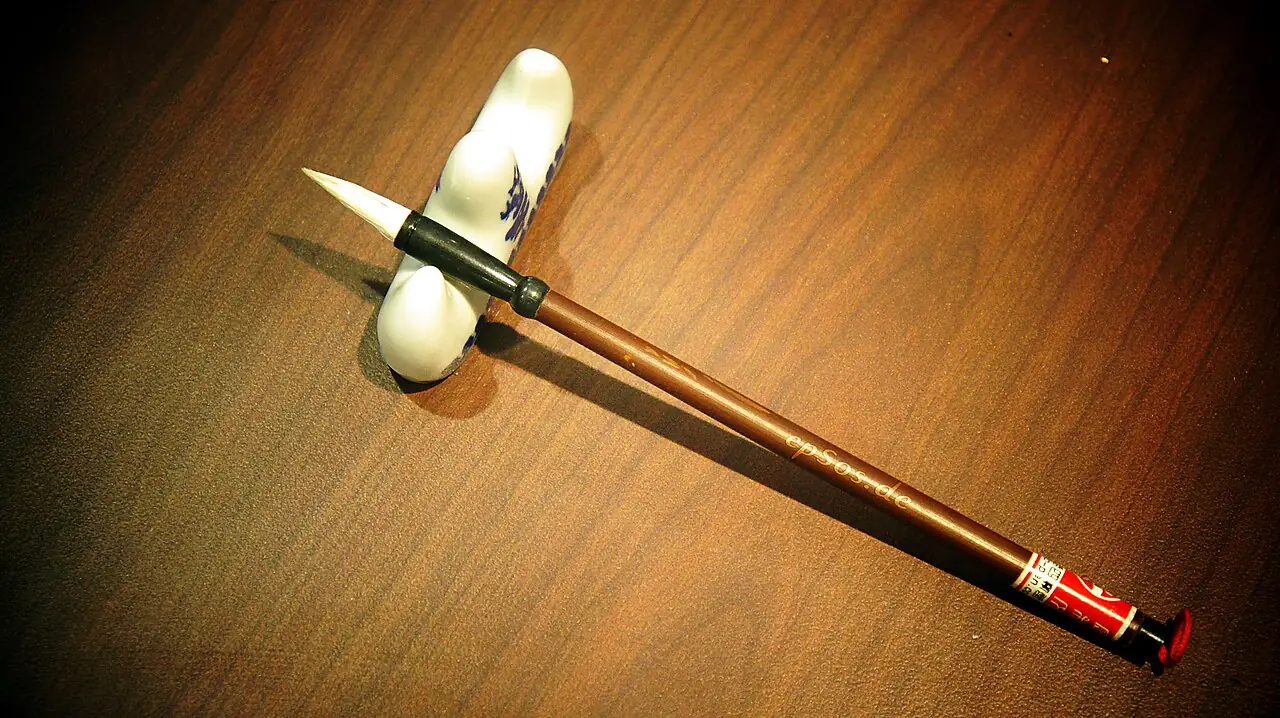
The practice centres on the four treasures of the study — brush (笔, bǐ), ink stick (墨, mò), paper (纸, zhǐ), and inkstone (砚, yàn) — each demanding intimate material knowledge. The ink stick is ground against the inkstone with water, the quality of the resulting liquid determining the depth and lustre of the mark on paper. The brush, traditionally made from animal hair (goat, wolf, or weasel) mounted in a bamboo or jade holder, is held in a specific grip that allows the wrist and arm to transmit power through the tip. The bamboo itself, alongside mulberry fibres used in papermaking, links calligraphy directly to the natural materials of the Jiangnan landscape. Every character is built from a fixed sequence of strokes, ordered by rules established through centuries of practice, and the calligrapher's task is to execute these strokes with precision while revealing personal expression — a paradox of freedom within discipline that echoes the yin-yang dynamic.
The effects of calligraphy extend beyond visual creation into physical and mental cultivation. The slow, controlled breathing required during long sessions is traditionally held to settle the mind, in a register comparable to the breathing practices of qigong. The brush technique demands whole-body engagement — the feet rooted, the spine aligned, the shoulder relaxed, the breath synchronised with each stroke — conditions that mirror the postural requirements of tai chi. Regular practice develops fine motor control, spatial awareness, and sustained concentration. The ancient principle that "the calligraphy reveals the person" (字如其人, zì rú qí rén) expresses the belief that brushwork exposes the writer's emotional state, moral character, and qi (气) vitality, making calligraphy both a diagnostic and a therapeutic discipline for the cultivated individual.
Calligraphy is deeply interwoven with other practices within the Chinese cultural system. It shares its toolset and aesthetic sensibility with Chinese painting, and ink sticks — the essential medium — are manufactured through a specialised craft tradition centred in the Jiangnan region. The rhythmic, flowing quality of calligraphic brushwork resonates with tai chi's continuous movement sequences, both practices emphasising breath coordination, structural alignment, and the unimpeded flow of qi. Calligraphy heightens the ritual atmosphere of the tea ceremony (茶道), where scrolls bearing brush-written couplets or single-character works hang in the alcove (床の間), and of the Spring Festival, when households replace old couplets with newly brushed wishes for the new year written on red paper. The materials of calligraphy — bamboo brushes, mulberry-fibre paper, silk mounting, jade or pine-wood handles — connect the practice to the natural world and to the craftsmanship traditions of porcelain, silk weaving, and bamboo basketry.
In The Way of Nature Atlas, calligraphy stands as the quintessential record-keeping and expressive practice — the art through which the human encounter with nature is inscribed, transmitted, and contemplated across generations. Its seasonal dimension is marked at the Start of Spring (立春, Lìchūn), the traditional occasion for writing new spring couplets and posting them at doorways to welcome the season's energy. The atlas presents calligraphy not merely as a decorative art but as the material trace of qi in motion: each character is a frozen gesture whose brush-tip pressure, ink density, and directional force preserve the precise bodily and emotional condition of its moment of creation. Through calligraphy, the atlas bridges the natural world of bamboo, mulberry, and pine with the cultural world of poetry, philosophy, and seasonal ritual, showing how a single brushstroke can contain the harmony (和谐) of a landscape and the timing of a season.