Entity Profile
Bamboo Basket
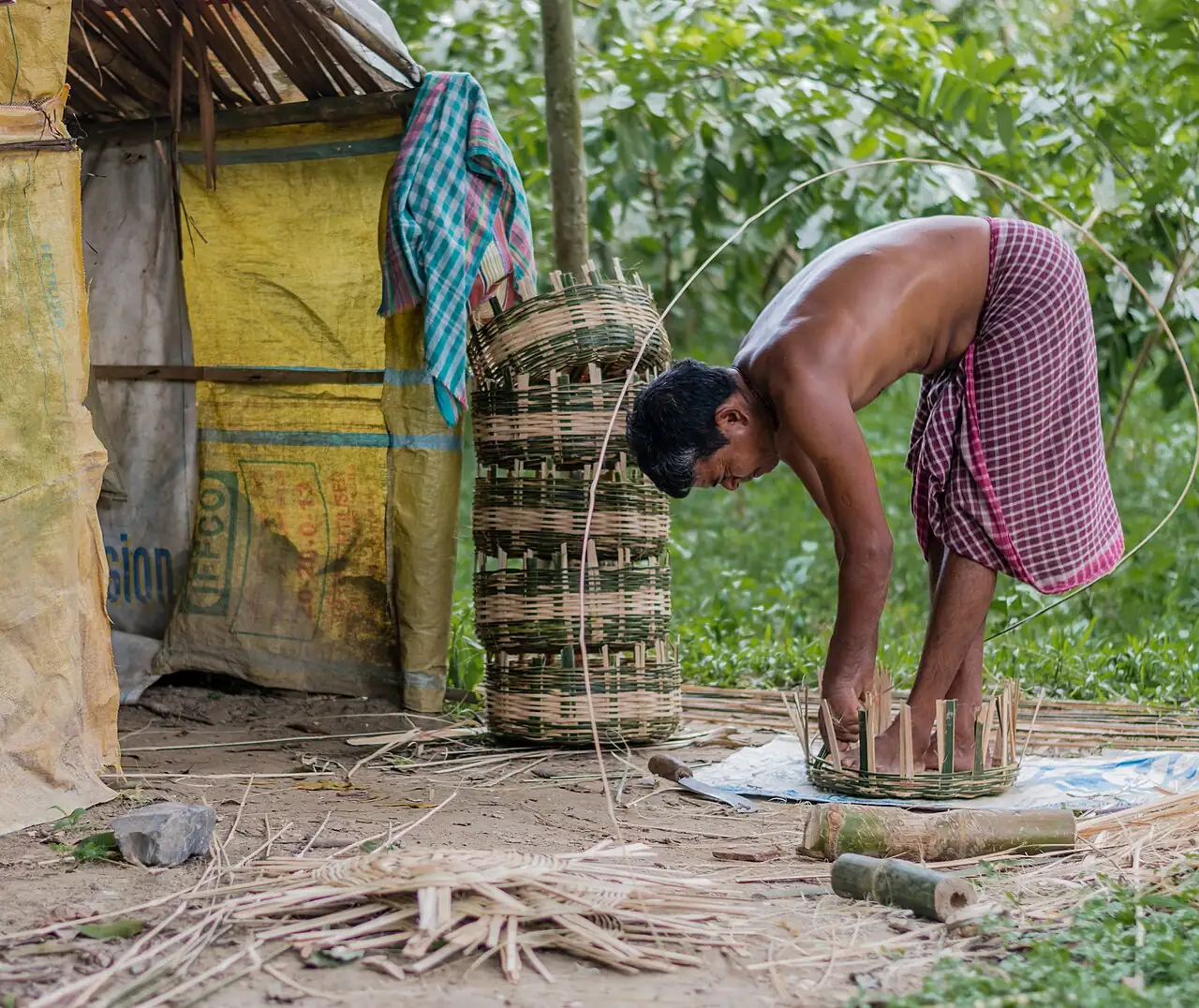
Bamboo Basket (竹篮, zhú lán) is a container woven from strips split from bamboo culms.
Artifact
primary type
Level 1
Concrete entity
15
relationships mapped
Bamboo Basket (竹篮, zhú lán) is a container woven from strips split from bamboo culms.
Bamboo Basket (竹篮, zhú lán) is a container woven from strips split from a bamboo culm. Bamboo is light, strong and flexible, and a single culm can be split lengthwise into many strips. Interlaced bamboo strips form the basket's walls and contribute to its structure.
The plaiting is the structure. Strips are woven over and under one another to build the walls, and the pattern of crossing can be read directly in the finished object. In Nagakura Ken'ichi's Woman (2014), one long piece of bamboo is split into many fine strips along its entire length—except for the last few centimetres—and then interlaced densely to create the finished form. In the Japanese bamboo work this page draws on, a number of plaiting patterns have names—hexagonal plaiting (mutsume-ami) is one, and twined and twill plaiting are others—and a maker's characteristic plaiting can be the most visible feature of a basket's structure.
What the Atlas draws from this object: a basket is a case where a material's properties and an object's structure cannot really be told apart. The strength and flexibility of bamboo are what allow the strips to be thin and the weave to hold, so the form of the basket follows from what the material can do. This is the Atlas's reading, offered as an interpretation rather than as a claim about any one tradition.
A basket is easier to understand if its three layers are kept apart: what it is made of, how that material is arranged, and what the arrangement is for.
| Layer | What it is | How it shows in the basket |
|---|---|---|
| Material, structure and use | ||
| Material | A bamboo culm, split lengthwise into thin strips | Bamboo is light, strong and flexible; a single culm can be split lengthwise into many long strips. |
| Structure | Bamboo strips interlaced to form the basket's walls | The pattern of crossing contributes to the structure of the piece. In Japanese bamboo work, hexagonal plaiting (mutsume-ami) is one named pattern, and twined and twill plaiting are others. |
| Use | A container made for a particular setting | In the Japanese examples discussed here, baskets serve as vessels for flower arrangements and tea-related settings. Isohi Setsuko's Tray with handle (2008) is one: it features hexagonal plaiting (mutsume-ami) and was made for flower arranging. |
Material and structure descriptions follow the National Gallery of Victoria essay "Bamboo: Tradition in Contemporary Form" (https://www.ngv.vic.gov.au/essay/bamboo-tradition-in-contemporary-form/), which describes bamboo's lightness, strength, flexibility and cylindrical structure, plaiting as a visible feature of a basket's structure, and hexagonal plaiting (mutsume-ami). The account of one long culm split into many fine strips that are then interlaced densely describes a specific work discussed in that essay, Nagakura Ken'ichi's Woman (2014), not a general production method; the tray made for flower arranging is Isohi Setsuko's Tray with handle (2008). The essay deals with Japanese bamboo work, so the named patterns and examples are given as Japanese cases rather than as general rules.
Each relationship represents a meaningful semantic link between Bamboo Basket and other entities in the Atlas knowledge graph.
Made from bamboo strips
View Bamboo →construction material
View Bamboo →Shoots harvested and carried in bamboo baskets
View Bamboo Shoot →Bamboo baskets store calligraphy scrolls
View Calligraphy →Cork as alternative natural material
View Cork →Lotus root harvested and stored in bamboo baskets
View Lotus →Bamboo baskets used for mulberry harvesting
View Mulberry →Bamboo is pandas food, bamboo baskets its cultural artifact
View Panda →Bamboo baskets used for rice washing and steaming
View Rice →Bamboo baskets used in silk production (silkworm baskets)
View Silk →Bamboo baskets used for tea processing and storage
View Tea →Bamboo baskets used in tea ceremony utensils
View Tea Ceremony →A bamboo basket is worked by using the tensile properties the material already has, rather than by reshaping the culm into a different object.
View Wu Wei →These entities share semantic relationships with Bamboo Basket in the Atlas knowledge graph.
Tea (茶) is an aromatic beverage made from the leaves of Camellia sinensis, originating in China over 4,000 years ago and ...
Rice (米/稻) is the seed of Oryza sativa, a cereal grain that is the staple food for more than half the global population, ...
Bamboo (竹子) is a fast-growing grass species in the subfamily Bambusoideae, native to East and Southeast Asia, valued for ...
Mulberry (桑树) is a genus of deciduous trees in the family Moraceae, native to warm temperate and subtropical regions of ...
Silk (丝绸, sīchóu) is a natural protein fiber produced by the silkworm (silkworm) (Bombyx mori) as it forms its cocoon
书法 (Shūfǎ) is the art of expressive brush writing that embodies China's philosophical and aesthetic traditions. Combinin ...
The panda (熊猫, xióng māo) is an iconic species native to the bamboo forests of Sichuan, Yunnan, and the Yangtze River ba ...
Wu-wei (无为) is non-coercive action: acting without forcing an outcome, so the natural course of things is not overridden ...
Lotus (莲花) is an aquatic perennial plant of the genus Nelumbo, native to Asia and Australia, revered in Buddhism and Hin ...
Tea Ceremony (茶道, chá dào — "Way of Tea") is the formal, ritualized practice of preparing and presenting tea as a spirit ...
Cork (软木, ruǎnmù) is a natural material harvested from the bark of the cork oak (Quercus suber), though in the East Asia ...
Bamboo shoots (竹笋, zhúsǔn) are the edible young culms of bamboo species, harvested when they first emerge from the groun ...
Bamboo Basket (竹篮) is a container woven from strips split from a bamboo culm. In the Atlas it is a concrete example of how a material's properties shape an object: bamboo yields long, strong, flexible strips, and interlaced strips form the basket's walls and structure. The page connects the plant material, bamboo, to the crafts and settings in which such baskets are used, including the display of flowers in the Japanese tea and flower traditions.
The Atlas reads the basket as a seasonal tool: an object whose working life follows the gathering and storage that each season brings.
An Atlas analogy, not a historical link: the basket's woven flexibility is compared here to the yielding-yet-strong quality of tai chi movement.
https://www.britannica.com/art/basketry
https://en.unesco.org/silkroad/silk-road-themes/tangible-cultural-heritage/bamboo-weaving
https://www.ngv.vic.gov.au/essay/bamboo-tradition-in-contemporary-form/
Dinamos Media B M · 23.6M views · YouTube ↗
Woodworking Enthusiasts · 1.6M views · YouTube ↗
Culinary science, seasonal eating, and ingredient knowledge. Owner of food-related entities and tea.
Owner since 2026-01-01