Yunnan (云南, Yúnnán, 'south of the clouds') is a province in southwestern China renowned for its extraordinary biodiversity, dramatic topography ranging from tropical rainforests to snow-capped peaks, and rich cultural diversity as home to 25 ethnic minority groups. It is considered the birthplace of tea and a global biodiversity hotspot.
Yunnan (云南, Yúnnán, 'south of the clouds') is a province in far southwestern China, characterized by its remarkable topographic diversity. The eastern half is a karst plateau dotted with limestone peaks and fertile basins, while the western half rises into the towering Hengduan Mountains, where glaciated peaks above 6,000 meters give way to deep river gorges carved by the Mekong, Salween, and Yangtze Rivers. The Yangtze River originates in Yunnan's northwestern mountains, and the province is related_to yangtze-river as the source of its headwaters.
Yunnan's climate is as diverse as its terrain, ranging from tropical monsoon in the southern Xishuangbanna region to alpine conditions on the highest peaks. This extraordinary range makes Yunnan one of the world's most biodiverse regions — a biodiversity hotspot containing more than 17,000 species of higher plants. The province is a secondary habitat for the giant panda (related_to panda), and is home to ancient tea forests where Camellia sinensis grows wild. Tea (茶, cha) originates_from yunnan, widely considered the birthplace of the tea plant. The province is also related_to mulberry cultivation, has distinctive sichuan-pepper varieties, and has a rich tradition of porcelain-making and fermented foods (related_to fermentation).
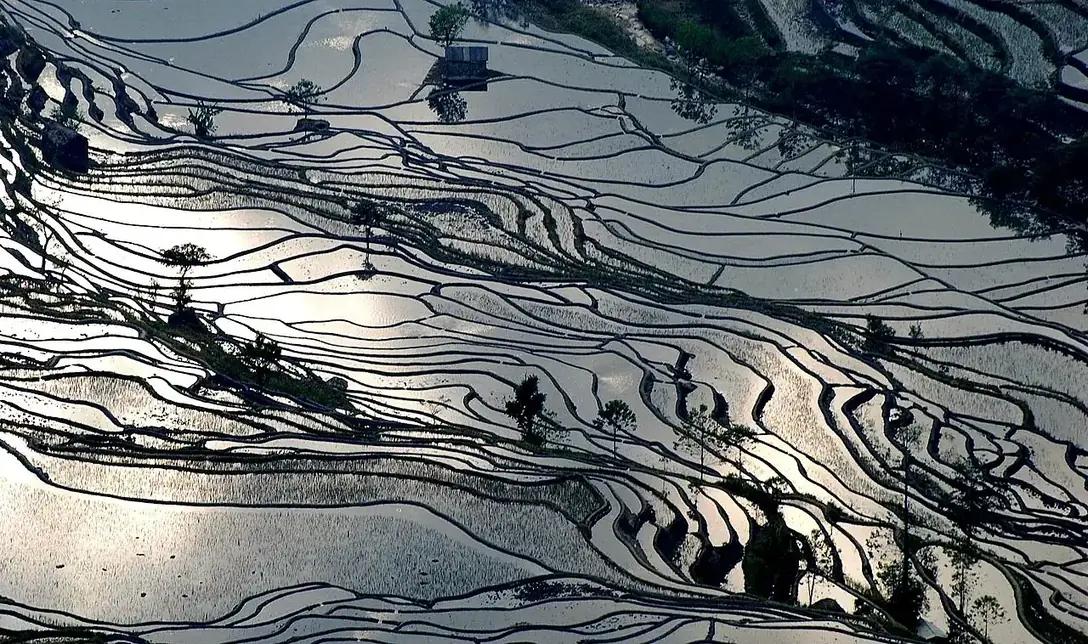
Yunnan's cultural landscape is as rich as its natural one, shaped by 25 officially recognized ethnic minority groups including the Yi, Bai, Hani, Dai, and Naxi. Each group maintains distinct languages, architectural traditions, festivals, and cuisines. The province's fermented foods — including Yunnan ham (宣威火腿, Xuanwei ham), pickled vegetables, and fermented soybean products — are celebrated across China. Spring tea harvest in Yunnan marks the beginning of the agricultural year, when the ancient tea mountains of Xishuangbanna and Pu'er come alive with plucking. The Wudang Mountains are geographically connected to Yunnan through the broader mountain system, and the province's landscapes — from the karst peaks of Shilin (Stone Forest) to the rice terraces of the Yuanyang Hani — represent some of China's most dramatic natural scenery.
Each relationship represents a meaningful semantic link between Yunnan and other entities in the Atlas knowledge graph.
These 24 solar terms mark when Yunnan appears, peaks, or transforms through the seasons.
Solar term #1 · Feb 3-5 · Wood
Spring tea harvest in Yunnan
View on Dao of Seasons ↗These entities share semantic relationships with Yunnan in the Atlas knowledge graph.
Mulberry (桑树) is a genus of deciduous trees in the family Moraceae, native to warm temperate and subtropical regions of ...
Sichuan pepper (花椒) is a spice made from the husks of prickly ash berries (Zanthoxylum genus), known for its unique numb ...
发酵 (Fājiào) is the microbial transformation of ingredients into preserved, flavour-rich foods central to Chinese cuisine ...
Tea (茶) is an aromatic beverage made from the leaves of Camellia sinensis, originating in China over 4,000 years ago and ...
The Yangtze River (长江, Cháng Jiāng) is the longest river in Asia and the third-longest in the world, flowing 6,300 kilom ...
The Wudang Mountains (武当山, Wǔdāng Shān) are a sacred Daoist mountain range in Hubei Province, northwestern China. Renown ...
The panda (熊猫, xióng māo) is an iconic species native to the bamboo forests of Sichuan, Yunnan, and the Yangtze River ba ...
Porcelain (瓷器, cíqì) is a ceramic material made by heating kaolin clay and other materials in a kiln at temperatures exc ...
Yunnan (云南, 'south of the clouds') is the Atlas's biodiversity capital—a province whose topographic range (tropical to alpine) creates one of the world's most biodiverse regions and is widely considered the birthplace of the tea plant (Camellia sinensis). Home to 25 ethnic minority groups, Yunnan's fermented foods, ancient tea forests, and distinctive ingredients connect Place to Ingredient (tea, mushroom, sichuan-pepper varieties), Plant (camellia, mulberry), Animal (panda), and Practice (fermentation).
Yunnan is the birthplace of tea—ancient tea forests in Xishuangbanna and Pu'er still contain wild Camellia sinensis.
Yunnan's fermented ham (Xuanwei ham), pickled vegetables, and pu'er tea represent some of China's most complex umami products.
Spring tea harvest in Yunnan's ancient tea mountains marks the beginning of the agricultural year.
Yunnan's 25 ethnic minority groups maintain distinct culinary, textile, and festival traditions unmatched in diversity anywhere in China.
Amazing Places on Our Planet · 1.0M views · YouTube ↗
Riri Travels · 620K views · YouTube ↗
Central Atlas — provides Overview pages for all entities. Does not produce original entity content, only aggregates and references.
Owner since 2026-01-01