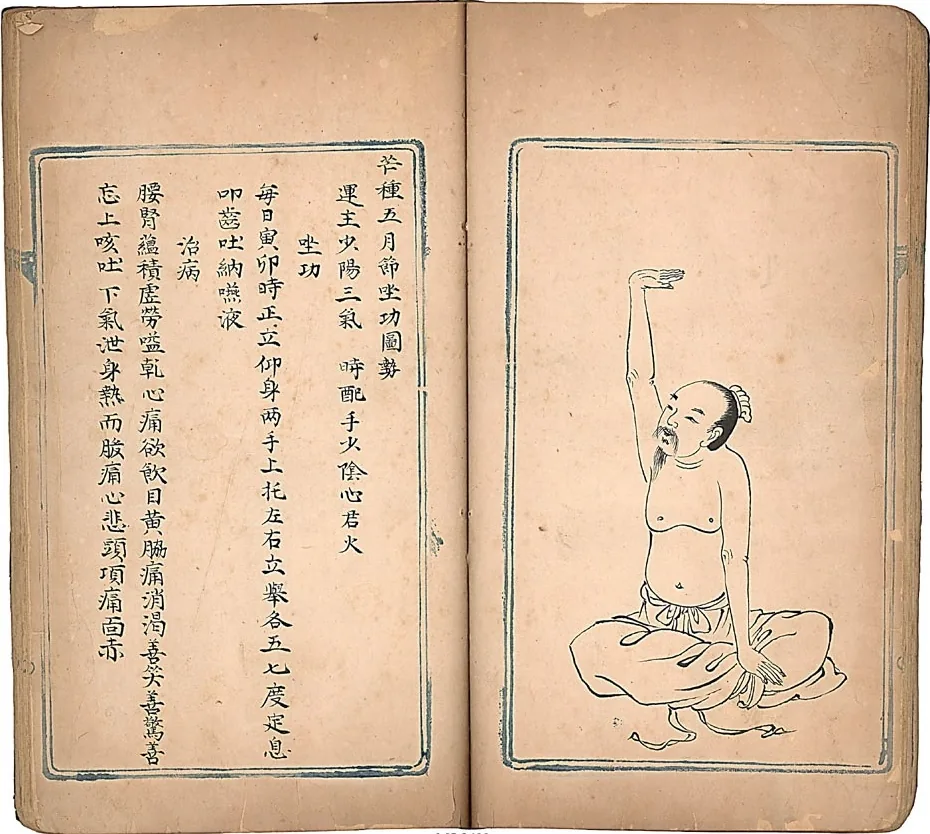
气功 (Qìgōng) is a system of coordinated body-posture, movement, breathing, and meditation practices developed within Chinese medicine, martial arts, and Daoist self-cultivation traditions. The term, meaning 'qi cultivation' or 'energy work,' encompasses thousands of distinct exercises ranging from gentle therapeutic movements to advanced alchemical practices. The origins of qigong are difficult to pinpoint because its constituent elements — breath awareness, gentle stretching, and meditative visualization — have existed in China since antiquity. The earliest known references appear in inscriptions on jade artifacts and bronze vessels from the Zhou dynasty (c. 1046–256 BCE) describing 'guiding and stretching' (导引, dǎoyǐn) practices. The Wudang Mountains (武当山), a Daoist sacred site in Hubei Province, have been particularly influential as a centre for developing qigong methods that integrate seamlessly with internal martial arts and philosophical Daoism (道家).
Qigong practice follows several broad methodological principles irrespective of the specific exercise. The practitioner begins by settling into a stable posture, typically standing, seated, or lying down, and brings awareness to the lower abdomen (丹田, dāntián). Breathing deepens into the abdomen — not forced but released, allowing the diaphragm to descend fully on inhalation. Movement, if present, is slow, continuous, and guided by the breath rather than by muscular effort. Many forms coordinate specific arm gestures or whole-body spirals with inhalation and exhalation, creating a somatic loop in which intention (意, yì) directs qi (气), breath delivers qi, and movement distributes qi through the body's meridian network. Standing meditation (站桩, zhàn zhuāng) — remaining motionless in a rooted posture for extended periods — is a foundational qigong method that builds the structural relaxation and internal awareness upon which all moving forms depend.
The effects of qigong practice are documented across multiple dimensions. Physiologically, slow deep breathing activates the parasympathetic nervous system, reducing cortisol, blood pressure, and heart rate while improving gas exchange and lymphatic circulation. Regular practice improves balance, joint flexibility, and core stability — outcomes that make qigong widely recommended for older adults at risk of falls. Energetically, within Chinese medicine theory, qigong is understood to clear blockages in the meridian network, smooth the flow of qi, and strengthen the body's protective energy (卫气, wèiqì). Psychologically, the focused attention and rhythmic breath induce a meditative state that reduces anxiety and improves mood. The harmony (和谐, héxié) that results — between body and mind, between the individual and their environment — is itself the therapeutic goal, making qigong a practice of returning to one's natural state rather than acquiring something external.
Qigong occupies a central position in the Chinese body-mind cultivation system, intersecting with multiple other practices. It is closely related to tai chi (太极拳), and many qigong exercises — particularly the widely practiced Eight Brocades (八段锦, Bā Duàn Jǐn) — are used as warm-ups or cool-downs in tai chi classes. Push hands (推手) and standing meditation (站桩) are structurally continuous with qigong: all three share the same breath mechanics, postural alignment, and internal awareness. The Wudang Mountains (武当山) tradition especially emphasizes qigong as the foundational practice before progressing to more complex taiji forms. Qigong also touches the decorative arts — the meditative calm it produces has been likened to the focused state required for porcelain painting, where each brushstroke on the curved surface demands utter presence. Through its core concept of qi, qigong connects directly to the Daoist (道家) cosmology that underlies the entire practice ecosystem.
In The Way of Nature Atlas, qigong serves as the foundational breath-and-body practice from which more specialized movement disciplines — tai chi, push hands, standing meditation — can be understood. It is the most accessible entry point for anyone wanting to experience the principles of qi, yin-yang (阴阳), and natural-timing (自然时序) directly rather than conceptually. The atlas presents qigong as a portable practice that requires no equipment, no partner, and no special location: only the practitioner's committed attention to breath, posture, and intention. It links the internal arts system to the broader themes of harmony (和谐) and ecological intelligence (生态智慧), demonstrating that the same principles governing breath flow through the human body also govern the circulation of energy through seasons, landscapes, and communities.