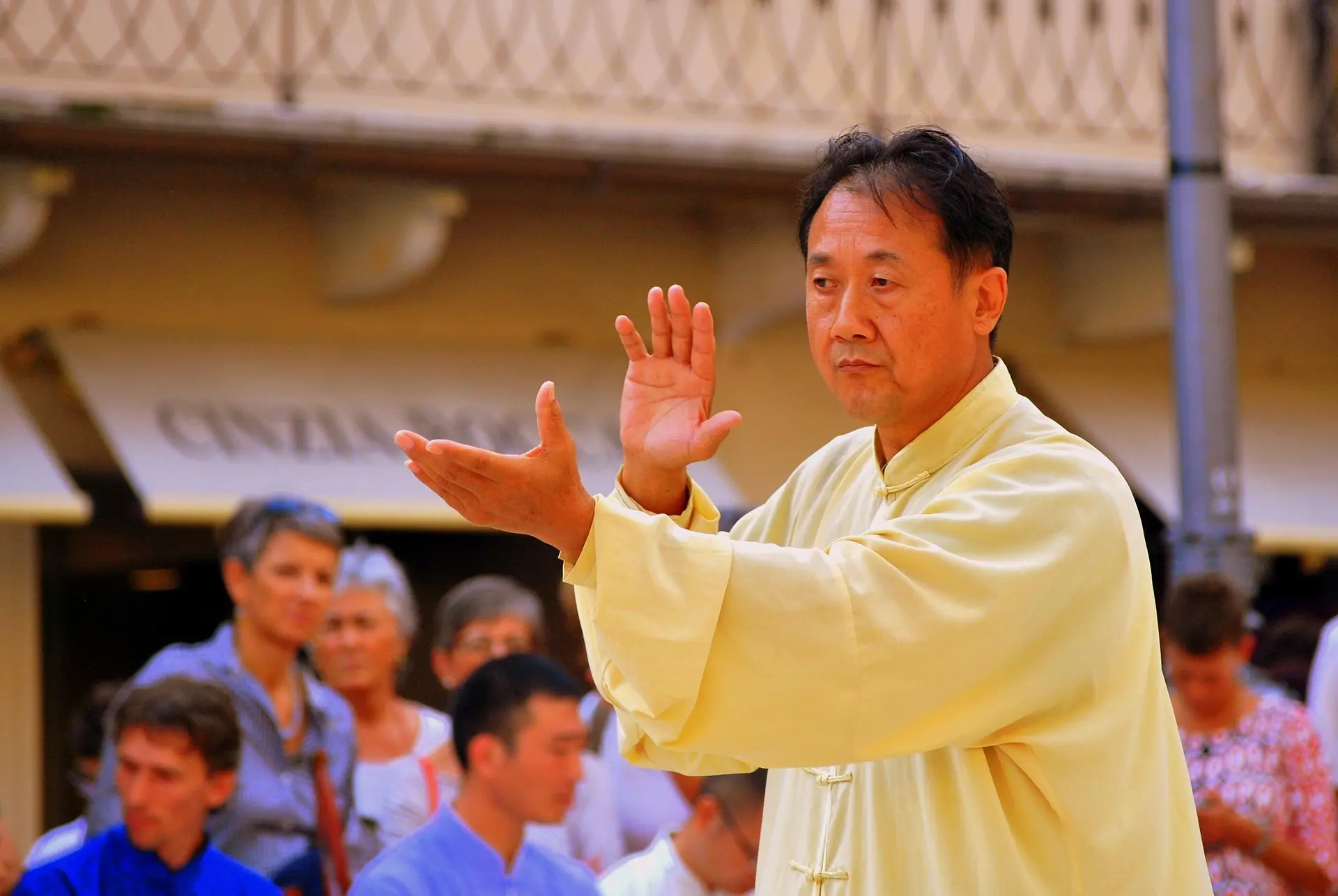
Standing Meditation, known in Chinese as 站桩 (zhàn zhuāng) — literally "standing like a post" — is one of the oldest and most deceptively simple practices in the internal arts. Its origins reach deep into Chinese martial and medical traditions, where it was developed as a method for building root, structural integrity, and the quiet, sustained attention necessary for all higher levels of neigong (内功, internal work). Unlike moving forms, Standing Meditation asks the practitioner to hold a static posture — typically the embrace-the-tree pose — for extended durations, transforming stillness into a profoundly active internal discipline. This practice is intimately tied to Daoist principles of wu wei (effortless action), teaching the body to align itself with gravity rather than resist it.
The core method of Standing Meditation revolves around a set of precise alignment cues that turn an apparently simple stance into a dynamic, whole-body structure. The feet are placed shoulder-width apart, knees slightly bent, as if sitting on an invisible stool. The tailbone tucks gently forward, the lower back relaxes, and the crown of the head lifts as though suspended by a thread from above. The arms form a rounded embrace in front of the chest, fingers softly extended and slightly apart. Fifteen to twenty distinct micro-adjustments are held simultaneously, creating an integrated system of balanced tension and release. The practitioner breathes naturally through the nose, allowing the mind to settle on the body's felt sensations — warmth, vibration, the subtle pulse of qi moving through the meridian channels.
The benefits of Standing Meditation unfold cumulatively over time, working on physical, energetic, and psychological levels simultaneously. Physically, it decompresses the spine, opens the hip and shoulder joints, and builds a deep, resilient structural strength that is relaxed yet unshakable — a quality martial artists call "root." Energetically, the still posture allows qi to gather in the dantian and circulate freely through the body's main channels, clearing blockages and restoring the body's natural flow. Psychologically, Standing Meditation trains the mind to find stability amidst discomfort, boredom, and distraction — building the capacity for sustained, non-reactive awareness. Many practitioners find that the calm, centred state cultivated in standing gradually permeates their daily activities, improving focus, emotional regulation, and resilience under pressure.
Standing Meditation occupies a unique place in the constellation of internal practices, serving as the quiet anchor that deepens all moving disciplines. It is the preparatory stillness from which Tai Chi forms flow, the structural foundation that makes pushing hands (推手) effective, and the energetic crucible in which qi is cultivated before being expressed through qigong sequences. The practice shares its deep logic of rootedness with the concept of natural timing — both teach the art of waiting, of being fully present in a single moment without grasping for the next. In Daoist thought, standing still and becoming empty is not passivity; it is the most direct way to align oneself with the Great Dao, allowing the natural order to move through an unobstructed vessel.
In The Way of Nature Atlas, Standing Meditation is presented as the foundational stillness practice — the essential counterpart to all moving arts and the gateway to authentic internal cultivation. It occupies a Practice entity role that demonstrates how doing nothing, done correctly, is among the most profound forms of doing. For atlas users, Standing Meditation offers a direct, portable, and endlessly deep method for experiencing the Daoist principle that in stillness, the whole universe comes to rest. It is the practice of letting the body become a tree — rooted, upright, patient, and alive with silent inner movement.