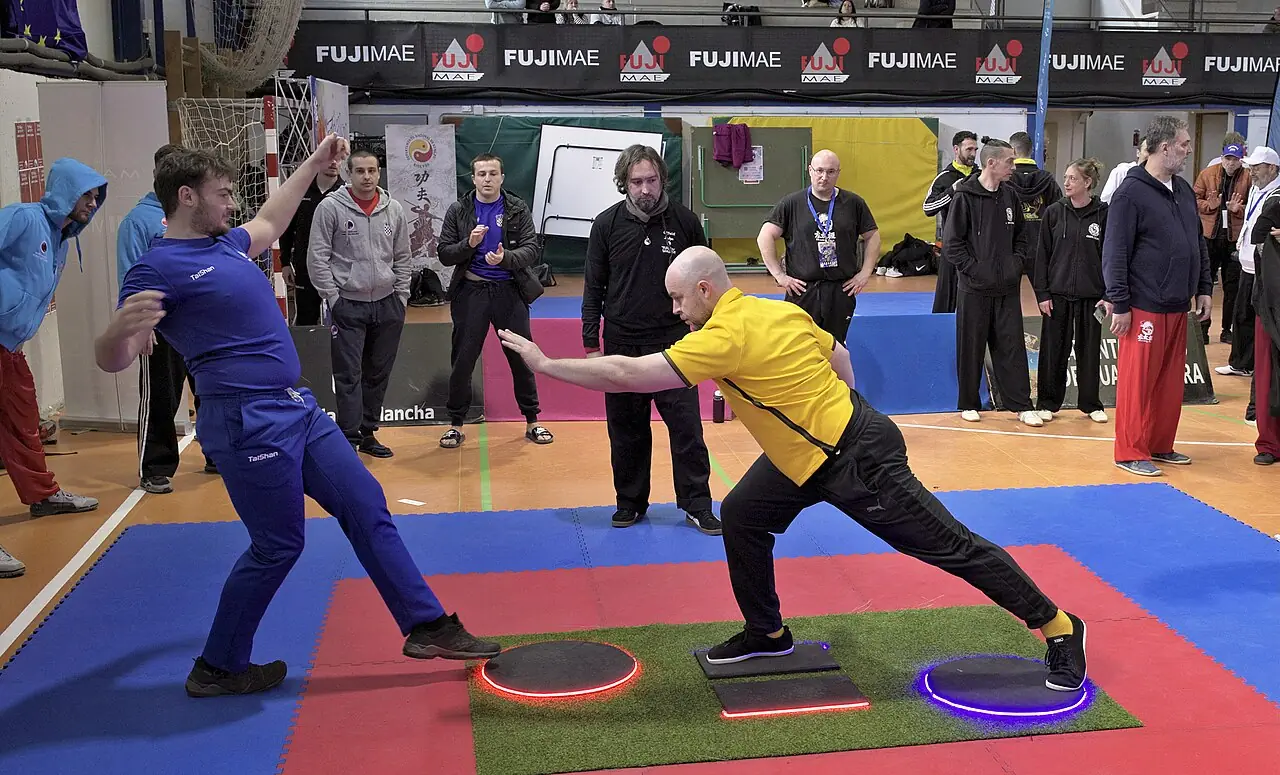
推手 (Tuīshǒu), or push hands, is a partnered sensitivity-training practice unique to the tai chi (太极拳) tradition, originating in Chen Village (陈家沟, Chénjiāgōu) of Henan Province. Unlike sparring, which emphasizes speed and impact, push hands develops tactile awareness, structural integrity, and the ability to yield, deflect, and issue power through controlled physical contact. As a two-person exercise, it translates the solo tai chi form's principles into relational dynamics: the practitioner learns to 'listen' (听劲, tīng jìn) through the hands — reading the partner's intent, weight distribution, and directional force through subtle pressure cues. The practice emerged in the 17th century as a bridge between solo form training and martial application, and it remains the essential method for developing the internal power (内劲, nèijìn) that defines tai chi as a martial art.
Push hands follows a structured progression from fixed-step patterns to free-moving engagement. Beginners start with a single-hand pattern: two partners maintain light arm contact, one 'pushing' (forward, adhering pressure) while the other 'yields' (absorbs and redirects). At every instant, both partners maintain the structural principles of standing meditation (站桩, zhàn zhuāng) — relaxed shoulders, sunk weight, aligned spine — while staying rooted through the feet. Advanced practice introduces two-hand patterns, stepping, and eventually 'moving-step' push hands, where partners circle and change stances without breaking contact. The definitive skill is the ability to neutralize incoming force by redirecting it into the ground and back through the partner's own structure — a technique requiring exquisite sensitivity to the energy (qi, 气) flows and weight shifts revealed through tactile contact.
The effects of regular push hands practice are both martial and therapeutic. Martial artists develop reflexive yielding and counter-force timing that cannot be acquired through solo practice alone. The body learns to distinguish genuine intent from feints, to dissolve aggressive force without bracing, and to express compact power at will. For health practitioners, push hands improves proprioception (the sense of body position in space), dynamic balance, and the ability to relax under physical pressure. The reciprocal nature of the exercise — one person's advance creates the other's retreat, and vice versa — enacts the yin-yang (阴阳) principle in real time, making it a living meditation on complementarity rather than confrontation.
Push hands is the partnered component within tai chi's broader training system. Its closest relative is silk-reeling (缠丝劲, chán sī jìn), the solo conditioning exercise that develops the whole-body spiral torque applied in push hands. Standing meditation (站桩) provides the structural foundation for both: a practitioner whose standing alignment is unstable will be instantly exposed in push hands. Qigong (气功) complements push hands by developing the breath control and internal awareness needed to distinguish genuine power from muscular force. The practice belongs to the Chen Village (陈家沟) tradition, where the Chen family developed both the solo forms and the push-hands methods from which the later tai chi schools are described as descending. Through its reliance on tactile sensitivity rather than visual speed, push hands remains distinct from competitive martial arts and closer to the relational arts such as tea ceremony and ritual (礼, lǐ), where meaning emerges through attuned interaction.
In The Way of Nature Atlas, push hands exemplifies the relational nature of all Chinese practice — the insight that mastery develops not in isolation but through attuned responsiveness to another. The atlas presents push hands as the kinetic counterpart to concepts such as yin-yang (阴阳) and harmony (和谐): what those terms describe philosophically, push hands makes physically verifiable through the body's own feedback. It connects the internal arts system — tai chi, qigong, standing meditation, silk-reeling — into a coherent training pathway where each element supports the others. For the atlas, push hands is the practice that proves the theory: theory without embodiment is empty, and push hands is the body's laboratory for testing whether one truly understands yielding, rooting, and the flow of qi.