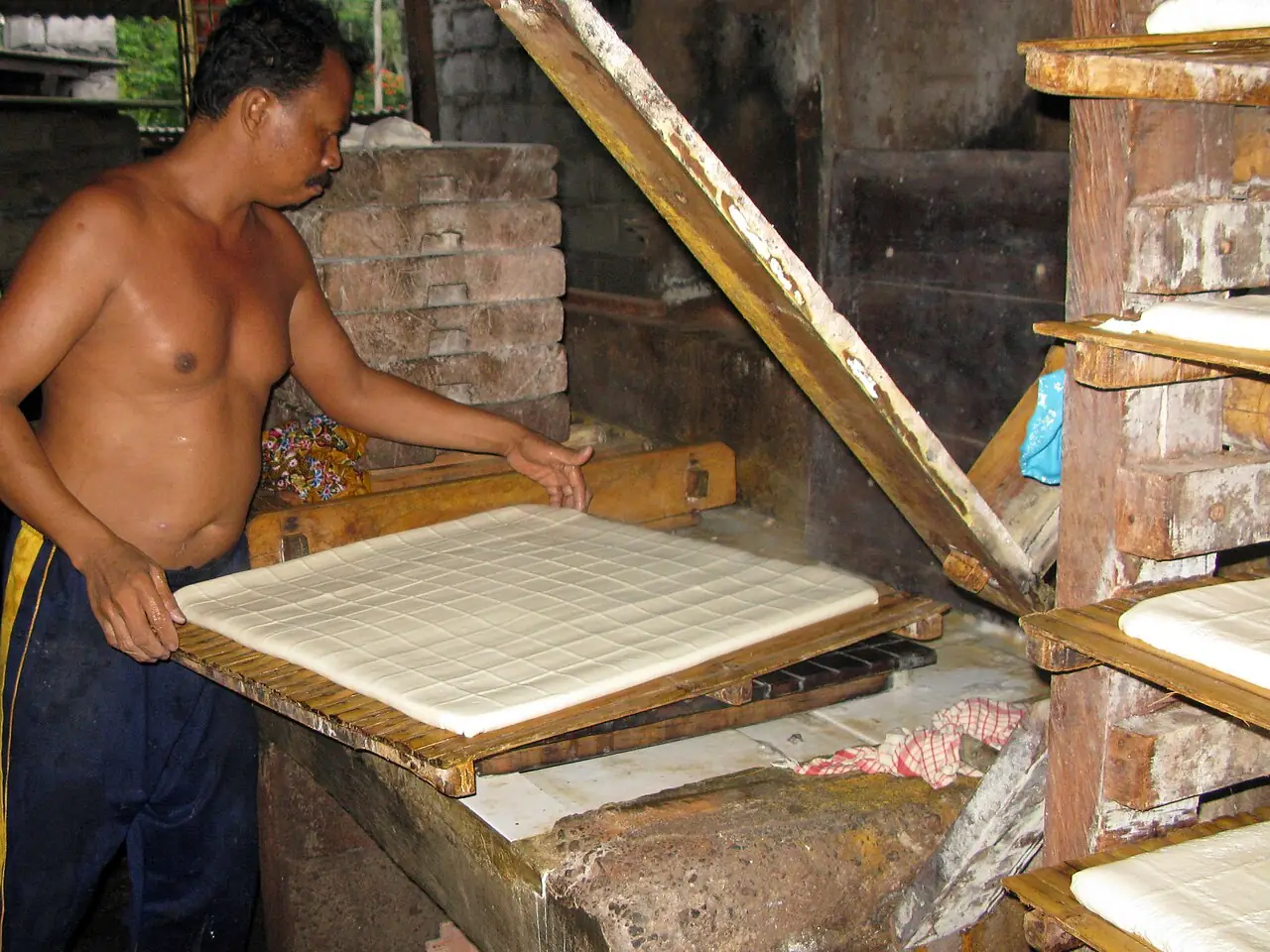
Tofu (豆腐, dòufu, literally "bean curd") is a food made by coagulating freshly boiled soy milk and then pressing the resulting curds into solid white blocks. For pressed tofu the process is analogous to cheesemaking: soybeans are the equivalent of milk, and a coagulant—nigari (a solution of magnesium salts) or a slurry of gypsum powder (calcium sulfate)—curdles the soy milk before the mass is shaped and pressed, giving consistencies from silken to extra-firm. Silken tofu is the exception: it is set by a different route that leaves no whey to drain, and its process resembles yogurt rather than cheese manufacture. That comparison concerns only how the product is set in its container; neither yogurt nor silken tofu is made by fermentation.
The production process begins with soaking dried soybeans overnight, then grinding them with water, boiling the mixture, and filtering out the insoluble pulp (okara, 豆渣, dòuzhā) to produce soy milk. The coagulant is stirred into the hot soy milk, causing it to separate into curds and whey. For silken tofu (嫩豆腐, nèn dòufu), the curds are not pressed, resulting in a smooth, custard-like texture. For firm and extra-firm tofu (老豆腐, lǎo dòufu), the curds are pressed under weights to remove more whey, producing a denser, chewier product.
Bean curd has been prepared and eaten in China for thousands of years. An FAO technical overview places a written record of tofu preparation in the second century B.C.; the original document behind that date has not been identified for this page. The invention is traditionally attributed to the Prince of Huainan, Liu An (刘安) of the Western Han. That attribution is recorded in a much later text—the 1596 Compendium of Materia Medica—and the sources cited on this page do not include a record from Liu An's own period. From China, tofu spread to Japan (where it became a cornerstone of Buddhist vegetarian cuisine, shōjin ryōri), Korea, and eventually throughout East and Southeast Asia. As a complete protein containing all essential amino acids, tofu was historically crucial as a source of nutrition in East Asian diets, particularly for Buddhist monks who observed vegetarian dietary precepts. Tofu's mild flavor and adaptability make it a canvas for countless preparations.
The versatility of tofu in East Asian cuisine is extraordinary. Silken tofu is used in soups (like miso soup or hot and sour soup), chilled as a summer appetizer (hiyayakko in Japan, with ginger and soy sauce), or blended into smoothies and desserts. Firm tofu is cut into cubes and stir-fried, deep-fried, braised in savory sauces (mapo tofu, 麻婆豆腐, being the most famous example), or grilled (yaki-dofu). Tofu is also a starting material for related products, and these derivatives should not be confused with tofu itself. Fermented tofu (腐乳, fǔrǔ), also known as "Chinese cheese," is made by ageing tofu in brine with rice wine and spices, and is a genuinely fermented product. Dried tofu skin (腐竹, fǔzhú) is not fermented at all: it is a dried film, lifted from the surface of continuously heated soy milk and then dried into sheets or sticks for stir-fries and hotpots. Nutritionally, tofu is an excellent source of protein, calcium (especially when set with calcium sulfate), iron, and isoflavones, which have been studied for their potential health benefits including reduced risk of heart disease and certain cancers.
Tofu and its relatives: what is fermented, and what is not
These products may share soybeans as a starting material, but they are made through different processes. The first four rows are tofu and its own derivatives; the last two are other soy foods, included to show the contrast in fermentation route. Where a comparison to another food appears, it describes how the product is set or shaped—not whether it is fermented.
| Product | How it is made | Fermented? | How it differs from tofu |
| Tofu and its own derivatives |
| Tofu (豆腐) | Soy milk curdled with a coagulant (gypsum powder or a solution of magnesium salts, nigari), then pressed. | No | The reference point. FAO groups tofu with soymilk as a non-fermented soy protein food. |
| Silken tofu (嫩豆腐) | A different route: soy milk at higher solids is set with glucono-delta-lactone, giving a homogeneous gel with no whey separation. | No | Same soy milk, different setting route. FAO compares its process to yogurt rather than to cheese manufacture; that comparison is about how the product sets in its container, not about fermentation. |
| Fermented tofu / Su Fu (腐乳) | A firm tofu is cubed, inoculated with mould (usually Mucor sp.), left about a week until mycelium covers the surface, then cured for months in brine with soy sauce, soy paste, spices and rice wine. | Yes | A preserved condiment rather than a fresh curd. FAO describes it as a white, creamy food resembling a semi-soft cheese. |
| Tofu skin / yuba (腐竹) | The film that forms on the surface of continuously heated soy milk, lifted off and dried into sheets or sticks; it can also be eaten fresh. | No — dried, not fermented | A dried derivative, and a common point of confusion: it is often listed beside fermented tofu products, but the transformation is dehydration, not fermentation. |
| Other soy foods, shown for contrast |
| Tempeh (天贝) | Cooked, dehulled whole soybeans fermented with Rhizopus moulds into a moist solid cake; Indonesian in origin. | Yes | Also mould-fermented, but it keeps whole soybean particles rather than curds. FAO lists it among the fermented group. |
| Soy sauce (酱油) | Cooked soybeans mixed with roasted wheat, inoculated with Aspergillus oryzae, incubated, then brined and pressed. | Yes | The liquid condiment. FAO lists it among the fermented group alongside miso and tempeh. |
Process descriptions and the fermented / non-fermented grouping for tofu, silken tofu, Su Fu, tempeh and soy sauce follow FAO, Soybean and Tofu Processing, Ch. 9: Tofu, Tempeh, Soy Sauce and Miso (https://www.fao.org/3/t0532e/t0532e10.htm), which classifies tofu and soymilk as non-fermented and describes bean curd as 'a product by itself or a starting material for a variety of related products, including fermented, salted, smoked, dried and fried derivatives'. The tofu skin row follows the Ministry of Agriculture, Forestry and Fisheries of Japan, which describes yuba as a film formed on the surface of soybean milk heated continuously, available fresh or in dried and molded forms (https://www.maff.go.jp/e/policies/market/dento_syoku/bunrui/mamerui-kakou.html).