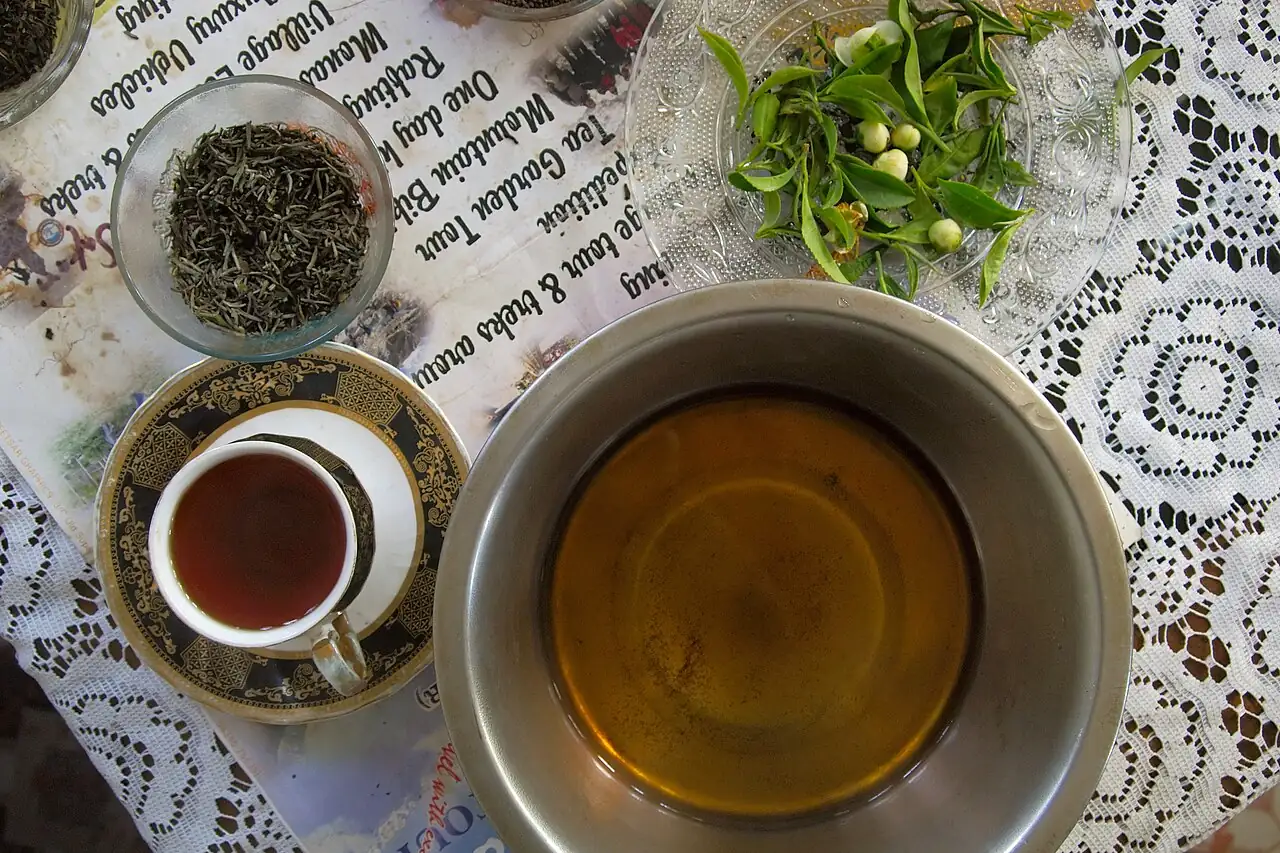
Black tea (红茶, hóngchá — literally 'red tea', so named for its reddish-amber liquor) is a fully oxidized tea made from the leaves of Camellia sinensis. Unlike green tea, which is heated to halt oxidation, black tea leaves are withered, rolled, and then exposed to oxygen for several hours until the enzymes within the leaf convert its polyphenols into the complex compounds responsible for its deep color, rich aroma, and full-bodied taste. The finished leaves range from dark brown to nearly black, with a liquor that can vary from bright copper to deep mahogany depending on the cultivar and production method.
Black tea is a sub_type_of the broader category of tea (茶, cha), distinguished by its complete oxidation process. The production involves several steps: fresh leaves are first withered under the sun or in controlled rooms to reduce moisture, then rolled to break cell walls and release enzymes, then spread in a cool, humid environment for oxidation to occur, and finally fired at high heat to arrest the process and lock in flavor. In China, famous black teas include Keemun (祁门红茶, Qimen Hongcha) from Anhui, with its orchid-like fragrance, and Lapsang Souchong (正山小种, Zhengshan Xiaozhong), which is dried over pinewood fires for a distinctive smoky character. Black tea is used as a beverage worldwide, consumed plain or with milk, sugar, lemon, or spices.
Black tea occupies a unique position in global tea culture. While China is the birthplace of all tea — with tea related_to lu-yu's The Classic of Tea codifying its preparation — black tea specifically became the driver of the global tea trade. During the 19th century, British demand for black tea shaped agricultural economies across Asia, leading to the establishment of tea plantations in India (Assam, Darjeeling) and Sri Lanka. In China, black tea is traditionally appreciated alongside green and oolong teas, and is considered warming (温, wen) in traditional Chinese medicine, suitable for cooler weather. The tea ceremony (related_to tea-ceremony) accommodates black tea alongside other varieties, and tea-brewing methods vary according to the leaf's character.
Black tea's seasonal harvests follow the natural calendar. The first flush (spring harvest) occurs during the T-grain-rain period around April, yielding the most delicate and flavorful leaves. The late spring harvest aligns with T-start-of-summer (early May), and an autumn harvest occurs around T-white-dew (early September), which produces leaves with a mellower character. A summer harvest related_to T-summer-solstice yields stronger, more astringent leaves suitable for blends. The specific processing of black tea — requiring controlled temperature and humidity during oxidation — also ties it to the concept of natural timing, as producers must work with ambient conditions to achieve consistent quality.
As a sub_type_of tea, black tea shares the parent entity's network of relationships. Tea originates_from sichuan, jiangnan, and yunnan — the three great Chinese tea regions. Black tea is related_to the practices of tea-ceremony, tea-brewing, and fermentation (oxidation being a form of controlled enzymatic fermentation). It connects to the cultural tradition established by lu-yu and documented in the-classic-of-tea, and pairs with soy-sauce in umami-rich culinary contexts.